🌐 Introducing: Knowledge Engine
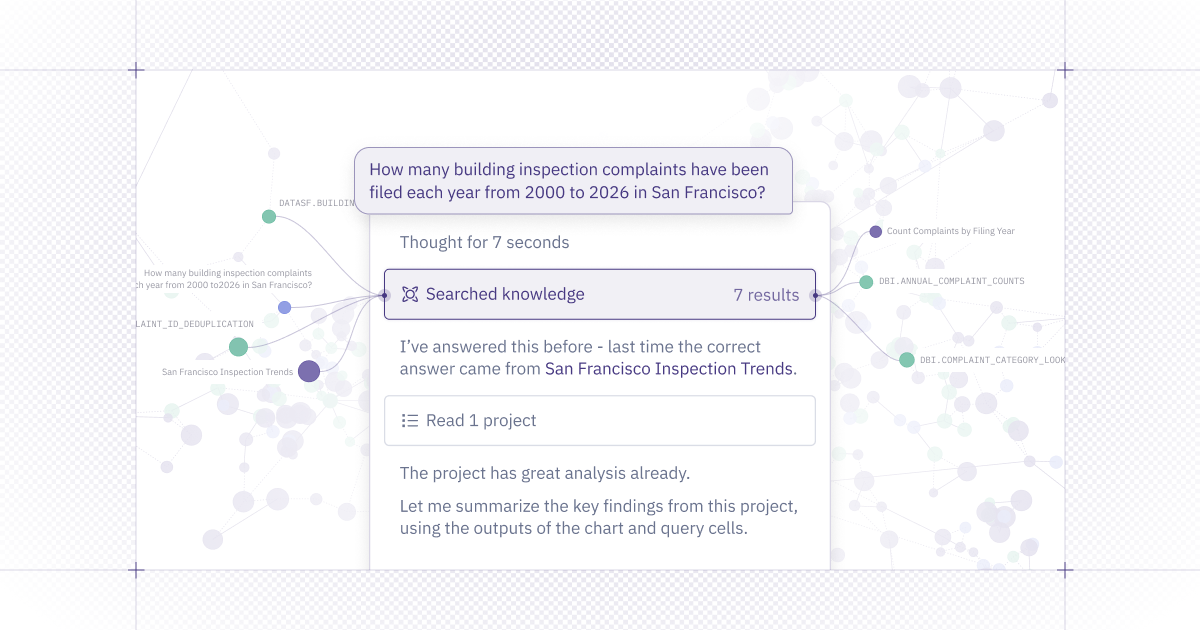
Every time an analytics agent is asked a question, it makes dozens of small decisions about which context and data to prioritize and how to interpret a user’s intent. But every new thread re-searches and re-reasons from scratch, spending time and credits, opening the door for inconsistencies and making judgment calls that are hard to observe at scale.
What if the knowledge agents discover along the way wasn’t thrown away, but retained, curated, and compounded? Now, Hex does exactly that, with our graph-based Knowledge Engine powering Hex 4.0. Read more in our launch blog.
How it works
Each night, a background curator agent reviews the day’s work in your workspace and identifies any new learnings from defined context, or judgment calls that agents made. It then reconciles them by merging duplicates, reinforcing existing knowledge, and flagging conflicting guidance.
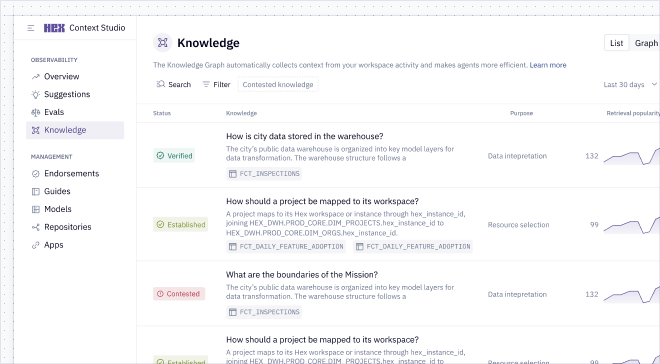
Once reconciled, each piece of knowledge is ranked by what it means and how the agent should use it.
- Verified knowledge is backed by defined context: a guide, a semantic model or an endorsed project
- Supported knowledge is a well-supported decision corroborated by available context
- Learning knowledge is a decision the agent had to make that is neither supported nor denied by available context
- Contested knowledge is where the agent has to make a decision where sources didn’t match up
- Debunked knowledge is shown to be incorrect, but used as a cautionary graph record
When someone asks a question in Hex 4.0, the agent will search the Knowledge Graph first for relevant knowledge instead of rediscovering context from scratch. This means not only fewer tool calls, but also fewer situations where agents divert from your trusted logic.
And the new choices or discoveries they do make? Those get reviewed in the background and reconciled with your graph.
🔭 Observing the facts agents know
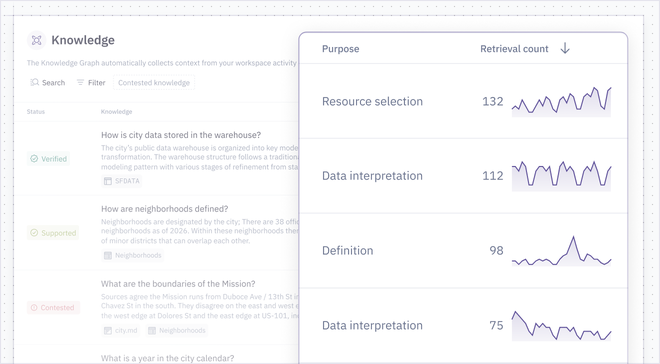
The graph functions as an observability surface into how agents are leveraging your existing context, what they’re learning from it, and what they’re having to come up with in the absence of clear guidance. So you can feel more informed about what context is working, and what you need to build or adapt.
👩💻 Getting started
If you’re using Hex 4.0, the Knowledge Engine will run every night and it will start powering your threads automatically. You’ll see knowledge powering agent thinking, and your threads will be faster.
In the initial beta, the Knowledge Engine only builds from sources that are accessible to everyone in your workspace. As we expand the beta, we'll evolve our authentication controls so as to safely expand its learning opportunities.
If you want to start exploring your knowledge, Admins and managers can head to Context Studio → Knowledge to review contested knowledge, which might indicate inconsistencies in your context layer or places where agents aren’t agreeing.
As graph usage builds up, use the newfound visibility to guide your decisions on where to invest in context management.
Manage learning and retrieval in Settings → AI & agents → Knowledge, and check out the Hex Learn docs for details.
The Knowledge Engine is rolling out in public beta alongside Hex 4.0. If you want to learn more about how we’ve rebuilt our entire platform to make analytical work faster, cheaper, and more accurate, join us at the Hex 4.0 Live Tour.