Connect to Athena (AWS)
Securely connect your Hex workspace to Athena (AWS).
- Users need the Admin workspace role to create a shared workspace data connection.
- Users need Can Edit or higher project permissions to create project data connections.
Writeback is not supported for Athena connections.
Athena is an Amazon Web Services (AWS) SQL query engine that allows you to do analytics on files stored in S3 (Simple Storage Service). It's not really a database; it's a way to use SQL on CSV and parquet files stored in the cloud. Athena runs on a fork of the open source Presto project that was first developed at Meta (fka Facebook).
The advantage of Athena is that you can start querying data quickly if it's already stored in S3. The disadvantages are:
- Because Athena is a query engine that can handle many different data formats, queries and reading schema metadata can be slow, which can affect performance in Hex.
- Athena's query engine is more limited and doesn't support as many analytical features as alternatives like BigQuery, DuckDB or Snowflake (no offset queries, for example).
Athena performance is highly dependent on how you choose to store your data. If you store carefully partitioned parquet files you may get reasonable performance. If you just store data in lots of large CSV files it might take minutes to query, which wouldn't be great for interactive exploration, even with Hex's caching. Amazon has a few good articles on tuning performance in Athena.
How to get set up
- Login to the AWS Athena console, or a create an account if you don't have one.
- Set up the credentials Hex will use to access Athena. Hex supports two authentication methods:
- AWS access key - Create an AWS secret access key for the IAM user with appropriate Athena access for your data connection (instructions to generate).
- IAM role - Create an IAM role that Hex assumes to obtain temporary credentials, so no long-lived secrets are stored in Hex. See IAM role authentication below.
- Currently only AWS users who do not use MFA authentication are supported.
- AWS uses the AWSQuicksightAthenaAccess policy as an example policy for JDBC connections. The IAM user or role will also need permissions to utilize prepared statements.
- Identify an S3 bucket to write query results to.
- In Hex, go to Settings → Data sources.
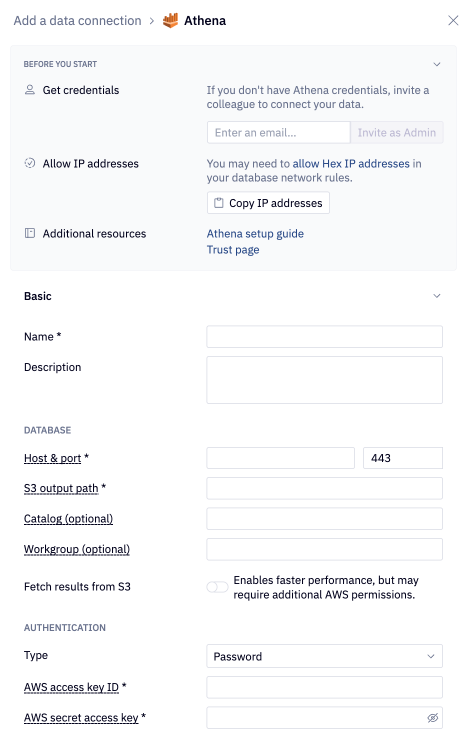
- Click + Connection, select Athena, and fill out the required fields.
Basic settings
- Name and Description - Set a display name and optional description to help identify your data connection.
- Host and Port - The default port is 443 and the host is
athena.[region].amazonaws.com(if you're using a VPC to connect then the host address is[vpc-specific-url].athena.[region].amazonaws.com). - S3 output path - The S3 bucket to which results will be written (e.g.
s3://acmeco/athena_results). - Catalog (optional) - The default catalog (data source) this connection should use. If no catalog is set, the default AwsDataCatalog will be used.
- Workgroup (optional) - The workgroup to use for the connection. If left blank, the primary workgroup will be used.
- Authentication type - Choose how Hex authenticates to Athena:
- AWS access key - Enter the AWS secret access key ID (the id for the secret access key for the IAM account that accesses Athena) and the AWS secret access key (the secret access key for that IAM account).
- IAM role - Enter the Role ARN for the IAM role Hex should assume. See IAM role authentication for the full setup.
You can't switch an existing Athena connection to use IAM role authentication. The authentication type must be configured when the data connection is first set up. To use IAM role authentication for an existing connection, create a new data connection.
IAM role authentication
With IAM role authentication, you don't store long-lived AWS credentials in Hex. Instead, you create an IAM role in your AWS account and grant Hex's AWS principal permission to assume it. Hex calls sts:AssumeRole to obtain temporary credentials, scoped by an external ID.
-
Create an IAM role in AWS
In the AWS IAM console, create a new role with a policy granting the Athena access described in How to get set up and a placeholder trust policy. Copy the role's ARN. -
Save a draft connection in Hex
In the Athena connection form, select IAM role authentication, enter the role ARN, and save the connection as a draft. -
Update the trust policy in AWS
Hex generates an external ID and IAM trust policy when you save the draft. Copy them into your role's trust policy in AWS. -
Finalize the connection in Hex
Return to the draft in Hex and complete the setup.
Hex includes the external ID on sts:AssumeRole but not on sts:TagSession. If your trust policy applies an sts:ExternalId condition to both actions, validation fails with an AccessDenied error on TagSession. Split your trust policy into separate statements (with distinct SIDs) and apply the external ID condition to sts:AssumeRole only.
Additional settings
The data connection form includes several optional sections:
- Advanced - Optional settings like custom SQL formatting, including schema data for AI, and connecting via SSH.
- Access - Optional data connection permissions.
- Schema browsing - Recommended settings like scheduling schema browser refreshes and schema filtering, both of which are recommended for performance and AI agent accuracy.
If you use a firewall to restrict database access, you'll need to add Hex's IP addresses to your allowlist.